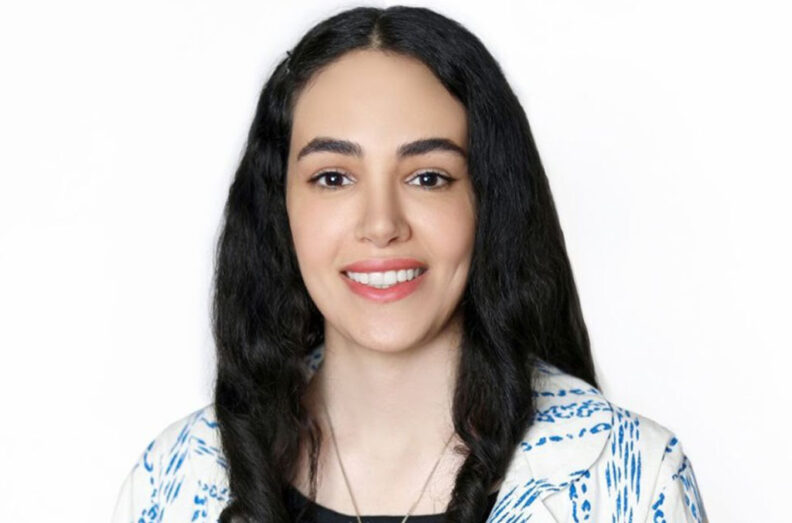

Talk Human to Me: Mahsa Zohrabi Aims to Make Artificial Intelligence More Transparent
By Eric Hollenbeck
As a second-year PhD student in information systems at WSU, Zohrabi is tackling an emerging issue that touches nearly every industry—from medicine to the gig economy, and even the applications we use on our phones and laptops: how to make artificial intelligence decision-making more understandable to people.
“AI systems make predictions and recommendations, but users often cannot tell why,” she says. “If the explanation doesn’t make sense, it won’t be helpful.”
Designing for Understanding, Not Just Efficiency
Zohrabi grew up in Iran where she earned both her bachelor’s and master’s degrees in industrial engineering. She began her career as a research and development engineer at an automotive parts manufacturer, where she conducted feasibility studies for new technologies.
Her master’s thesis focused on the Internet of Things—the physical devices and objects connected to the internet that collect and share data, such as smartphones, automobiles, appliances, and smart-home systems. She later assessed automation options for Iran’s national railway sector. The work sharpened two instincts—she liked solving hard problems with real-world consequences, and she wanted to trace cause and effect.
“In industry, you are assigned tasks, but it’s hard to see your contribution to the big picture,” she says. “I was more motivated by research.”
Engineering a New Path Forward
When it came time to apply for PhD programs, Zohrabi focused on the United States. After receiving multiple offers, she chose WSU for its alignment with her interests and the strong research profiles of the Carson College of Business faculty.
Today, her primary research projects examine explainable AI. While computer scientists develop techniques to uncover the reasons behind AI decisions, Zohrabi studies the next step: whether those explanations are actually understandable to the humans who need them. She draws on cognitive psychology and communication research to design surveys and experiments that help her gain greater insight into making AI more relatable to human understanding.
“You can see a version of this in daily life with generative AI,” she says. “A system gives an answer, but you’re not sure if it’s grounded in evidence. Confidence depends on clarity.”
Another project she’s involved in—led by her PhD advisor, Richard Johnson, professor of information systems—explores whether employees prefer to receive feedback from an AI system or from a manager. Early pilot results suggest participants were more comfortable receiving negative feedback from AI than from a supervisor.
Zohrabi plans a larger data collection in the spring of 2026 to validate those initial results and aims to submit a paper next year. Both projects reflect an interest in transparency that she says was sparked by observing the types of jobs that make up the “gig economy.”
“Uber drivers are managed by algorithms,” she says. “They don’t always know how pay is calculated or why certain decisions happen. Workers ask for transparency. I felt research could help with a real-world problem.”
Finding Her Footing in Academia
Mentorship and support have shaped Zohrabi’s academic experience, from the program’s thoughtful structure under department chair Robert Crossler to her advisor’s strong focus on professional development.
“Learning how to do research and behave professionally in academia is essential,” she says. “I’ve had guidance on how to respect your cohort and faculty, and how to build good relationships with students.”
Zohrabi also serves as a teaching assistant and co-taught an online summer course in 2025. She says she wants to continue growing as an instructor.
Long-term, Zohrabi hopes to publish at least one strong paper during the program, recognizing that high-quality research can take several years to mature. She aims to graduate in 2029 and pursue an academic career that blends research with teaching.
Her advice to prospective students is simple: WSU is a great place to pursue genuine research interest, but motivation is essential.
“Give yourself time,” she says. “By the second semester, you start to find your path.”