
Carson College Annual Events Offer Insights on the Interface of Business and Technology
By Sue McMurray

Professor Joe Valacich Delivers Inaugural Hubman Distinguished Lecture
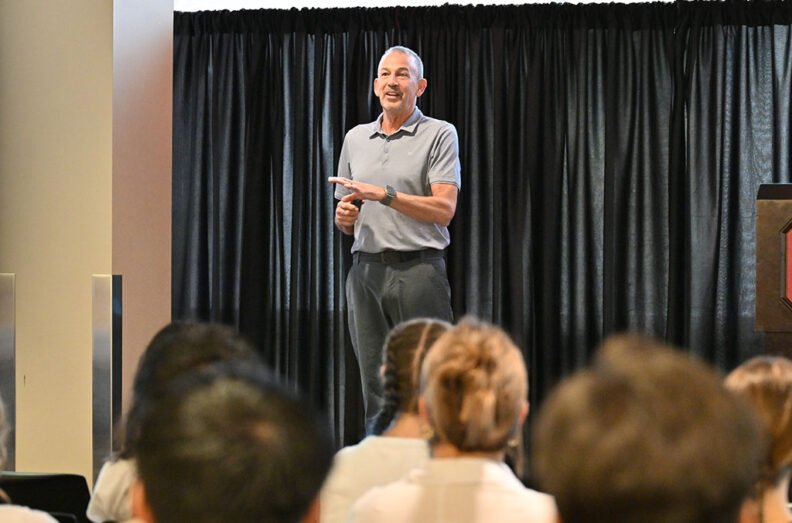
University of Arizona Professor Joe Valacich, the first holder of the WSU George and Carolyn Hubman Distinguished Professorship, returned to Pullman in early September to deliver the inaugural Carson College of Business Hubman Distinguished Lecture.
“I loved my time here,” he says. “Being the first Hubman Professor and helping build the management information systems program was wonderful.”
Valacich is a prolific scholar and innovator in human-computer interaction. His presentation, “Agile Development, Lean Start-Up, and Lessons from a Tech Start-Up,” shared insights from his entrepreneurial experience.
In 2014, Valacich cofounded Neuro-ID, which analyzes how users type, swipe, or tap to detect fraud and improve online experiences. In 2024, Experian acquired the company to enhance its digital identity tools. Neuro-ID’s data guides underwriting and helps online ecommerce venders assess risk and spot bots or scammers in real time.
Valacich notes 90 percent of start-ups fail due to high financial burn rate, overly ambitious goals, large management teams, and misjudging customer needs.
A lean approach—creating value for customers with fewer resources—is key to a company’s efficiency and its ability to learn and evolve, he says. He contrasted traditional waterfall methods, where problems and solutions are predefined, with agile approaches that use customer feedback to identify technical and business solutions.
Valacich’s key lessons for start-ups include appointing strong leaders, fostering a trustful culture, securing top financial and legal advice, creating a compelling value proposition, and keeping work enjoyable.
“It isn’t often an academic is able to impact research and industry so significantly,” says Carson College Professor Robert Crossler, current holder of the Hubman Distinguished Professorship. “Joe’s work with Neuro-ID exemplifies exactly how to do that, and his visit was a great learning opportunity for students.”

CIOs Jason Stefanski, Joe Guptill Headline Business Technology Symposium
The world’s increasing reliance on technology and data is shining a spotlight on management information systems (MIS), one of the fastest growing fields in the workforce and the highest paying for business majors. To inform WSU students and the WSU community about the exciting career opportunities in MIS, the Carson College’s annual Business Technology Symposium featured industry experts Jason Stefanski (’98) and Joe Guptill (’98).
The two spoke about their individual career experiences and roles as chief information officers in their respective companies.
Stefanski, CIO at GeoEngineers, says it was the blend of business and technical skills that made him pivot from accounting to MIS as a WSU undergrad.
“MIS includes everything in business, plus the technical side,” Stefanski says. “ I still use what I learned from my WSU Database Structures class.”
After graduating, Stefanski gained teamwork skills and leadership experience in a variety of industries. Thanks to his formal MIS training, he says he solved a database issue no one else in his company could. This led to additional opportunities for higher levels of responsibility and leadership roles. Today he leads GeoEngineer’s vision, strategy, and technology direction. This includes managing technology initiatives and being a mentor to several other group leaders.
Guptill, CIO at Guimont Capital and the CEO and owner of VMS Technology, also explored other majors but says he was drawn to MIS because of the quick application of technology to solve issues, and he liked the mix of students in different disciplines who took MIS classes.
Early in his career, he fostered the skills he learned at WSU, such as programming, accounting, database structures, finance, and communication. “There’s value in differentiation. Get as much diversity in your education as you can while you’re in school,” he says.
Guptill says he was always willing to step in and fill a void in the companies he worked in, which created a pathway to higher-level responsibility. He viewed challenges as an opportunity to grow his leadership style, customer service skills, and work relationships.
“I learned to pivot away from my own accomplishments and focus on my teams’ accomplishments,” he says.
In reflecting upon the evolution of their own careers, Stefanski and Guptill highly recommend that students complete an internship before their senior year and develop a strong LinkedIn profile to enhance networking opportunities. They also recommend learning how to leverage generative AI tools as sources of ideas, not sources of truth.
Walton Lecture Showcases Micron Expert Collin Sower’s Risk Management Method
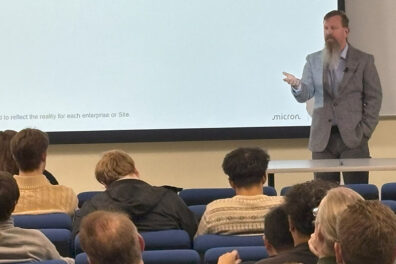
As the global leader in semiconductor memory, Micron Technology requires a robust risk management program and an experienced leader. That role is filled by Collin Sower, senior risk manager, who delivered the Walton Lecture, sharing insights about a method he developed to quantify and prioritize operational risks Micron faces.
Sower’s method entails assigning a risk priority number (RPN) to each risk event. The RPN uses three criteria: severity, occurrence, and detection to quantify operational risks. Each criterion is rated on a 1 to 10 scale, with 10 being the least desirable. For example, a severity score of 10 could indicate a fatality or loss of body functions, or government regulation non-compliance without warning. An occurrence score of 10 means the frequency of a risk event is very high, more than monthly. A detection score of 10 means a risk event is almost impossible to detect, and there is no detection control in place. Sower says Micron employs a custom approach to RPN severity that considers alignment across groups, environmental, health, safety, and financial impacts.
“One novel approach is considering business interruption for each scenario,” Sower says. “We can break down business interruption per site down to the year, month, day, or hour and calculate a score to identify financial impact.”
Sower described a scenario in which a 6,000-volt transformer with no auto transfer switch experienced a failure, seriously damaging the transformer and causing it to trip offline. Using Sower’s rating method, severity showed no injuries, occurrence showed regular inspection, and detection showed human awareness of lights going out. That evaluation determined the best solution was to install ATIS ground fault relays for $260,000 over three months, he says.
The value in this process lies in the ability to apply a rating that can identify where money needs to be spent and the most efficient application. This helps Micron reduce subjectivity, inform its budget managers, and negotiate appropriately with insurers, Sower says.
“A strong risk management process provides quick, clear decision-making guidance for executives and justifies to our internal external audiences why we do certain things ,” Sower says.