Building Empathy in Caregiving Through Virtual Reality
By Scott Jackson
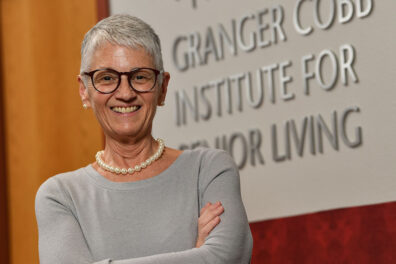
After agreeing to participate, Founding Director Nancy Swanger and two of her students tested the program firsthand, exploring how immersive technology could help caregivers build deeper understanding through simulated real-world challenges.
Experiencing dementia through another lens
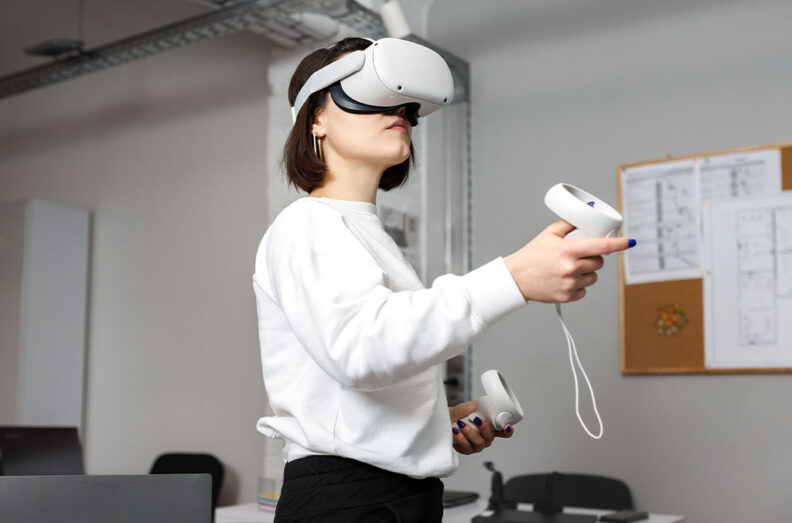
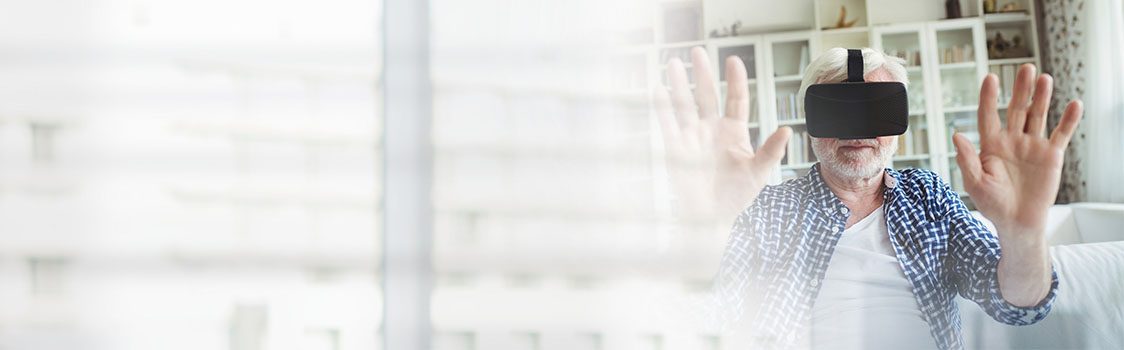
In the program, participants donned a VR headset and performed everyday tasks that slowly became confusing or illogical—mimicking what someone with dementia might experience.
For example, Swanger says one memorable exercise instructed the participant to move a red pill to a corresponding box, only for the visuals to suddenly shift until the box was in another location or the pill had changed color. Participants say the exercise would quickly become exasperating.
“You see how frustrating it is when you think you know what you’re doing, your mind feels like it knows what it’s doing, but the connection is not there,” says Lillian Samuels (’28 Aging, Finance) who participated in the program. “You get the real-life experience of how confusing everyday tasks can be for them.”
Rendever’s platform also includes a virtual assistant named NOVA, who helps guide users through the training. Swanger says this kind of training opens new possibilities and improves mutual understanding for caregivers, offering a safe, immersive way for them to understand a reality they might one day encounter.
“It enhances people’s empathy,” Swanger says. “Trying to walk in someone else’s shoes is really hard, but this is one of those businesses where you need to do that.”
Preparing students for real experience
Beyond empathy, the technology gives students a preview before they enter senior-living communities for work experience.
“It’s just a great way to break the ice so they’re not so shell-shocked when they have to deal with something face-to-face for the first time,” Swanger says.
She sees similar promise for educators. Experiential learning is a powerful instructional tool, but it’s strongest when connecting students directly to evolving practices. She stresses that without industry involvement, these kinds of opportunities would not be possible.
“This is where the rubber hits the road—this is as current and as innovative as it gets,” Swanger says. “Our students are hearing from the people who do it and who are living it in the moment.”
Looking ahead, Swanger says she expects VR and other emerging technologies to continue reshaping senior-living education while reinforcing, not replacing, the human side of care.
“AI and technology aren’t going to replace the human connection this industry needs to thrive.” she says. “What they can do is take away the mundane, boring tasks that free people up to spend more time with residents—the part that matters most.”
Expanding student experience through industry ties
Swanger says partnerships like this one reflect the institute’s commitment to giving students direct exposure to a field many have never considered.
Connections with industry help keep the institute grounded in the latest technology and innovations in the senior-living field and can change how students view senior living altogether. As a career path, she says students aren’t always aware senior living is an option that draws a diverse range of professionals. However, for a generation that wants their daily work to be meaningful, it’s often a surprisingly good fit.
“What could matter more than making a positive difference in the life of an elderly person every single day?” she says. “This is an industry that takes engineers and artists and musicians and sport-management people. If you have the right heart, there’s a place for you.”