By Sue McMurray
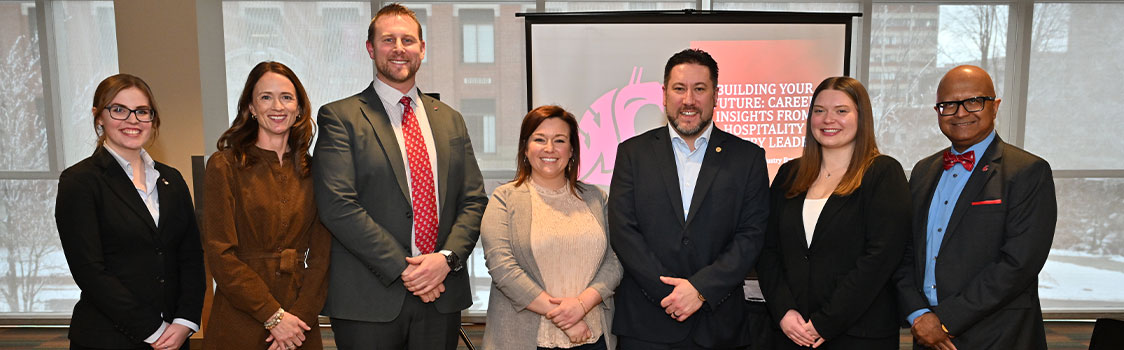
A job in the hospitality industry is more than just a job. It’s a feeling that stems from the heart, according to an industry panel discussion during the Carson College’s annual Hospitality Week of events.
“In hospitality, you’re part of something special,” says Renee Petitjean, a recruiting manager for Marriott International. “I’m addicted to making a difference.”
Petitjean, along with other hospitality experts Jordan Pitre, Joshua Rockwell (’09), Margaret Bader (’22), and Molly Wolniewicz (’01), shared business insights with students considering hospitality careers in a discussion moderated by Dipra Jha, Carson College associate professor (career track) of hospitality business management.
Navigating career changes and challenges
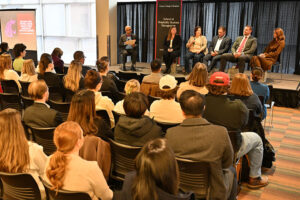
While Petitjean, Bader, and Wolniewicz earned undergraduate degrees in hospitality and went to work in the industry after graduating, Pitre and Rockwell had different careers before finding their way into hospitality.
Pitre is the executive director of the Evergreen Chapter, Club Management Association of America, and the general manager of the Fairwood Golf and Country Club. He worked in his family’s hospitality business as a youth but earned music and math degrees. He pursued a music career but ultimately found more joy while working as a bar manager. Tending bar led to food and beverage director positions before he joined the CMAA.
When Jha asked the panel about challenges they had faced in their careers, Pitre said he always felt behind because he didn’t have a hospitality degree.
“When I first got into management, I had to figure out how to get the respect of people who had been working in the industry for 20-plus years,” Pitre says. Working with a mentor helped him grow professionally and was a great way to learn, he says. “You don’t have to know everything, especially at entry level positions. When I’m hiring, I look for someone with a hospitality heart and an eagerness to learn.”
Rockwell, food and beverage director at the Coeur d’Alene Resort, was in the military before deciding to become a chef and eventually a sommelier. Over the last 20 years, he’s had diverse food and beverage leadership positions and successfully led teams.
“Success comes with time,” he says. “Work/life balance is important; in our industry, that ebbs and flows with the seasons. You have to find ways to take time for yourself in a job that’s not always 9 to 5.”
Wolniewicz, a senior living sales consultant and mentor, started out working in sales management for hotels before moving to senior living. She acknowledged the demanding culture of the hospitality industry but emphasized the value of a strong work ethic.
“Once you graduate, it’s time to hustle,” she says. “Companies are becoming more aware of mental and physical health, but don’t limit yourself or your efforts.”
A recent graduate, Bader works as an event manager and guest experience captain at Aerlume, a Seattle restaurant. She found it challenging to retain relationships when she worked nights.
“When you figure out what you want to do, find something that fits you,” she says. “Through different stages of your life, look to leaders who can help you get there.”
Skills for the future
Given the hospitality industry was the hardest hit during the pandemic, Jha asked the panelists to speak to post-COVID-19 trends that have remained in the industry. One of the biggest challenges is the lack of employees, prompting industry leaders to rely more on artificial intelligence and other advances in technology to create efficiencies, such as scanning résumés. Future employees must be prepared to embrace new technology, according to the panelists.
“Don’t be afraid of AI,” Wolniewicz says. “It’s now used in restaurants, hotels, and senior-living communities.”
Bader says she uses AI to be more creative and develop new cocktail ideas. Pitre’s company uses AI in onboarding videos produced in different languages. Petitjean says while AI is not used to scan résumés at her workplace, it is used for auto scheduling and other efficiencies.
“Be innovative as technology increases,” Rockwell advises, “and be relevant in your industry.”
Besides technology, the skills future hospitality leaders need hinge on experience, ability to solve problems, positive attitude, and communication.
“Being open minded is key,” Petitjean says. “In uncomfortable situations, you have to shift your mindset from ‘I have to’ to ‘I get to.’ Your learning will increase from being in uncomfortable situations.”
The panelists had several tips for first-year hospitality students, including finding a common connection when speaking, participating in networking events, and talking to at least 10 industry professionals.
Bader recommends students research the companies they’re interested in before attending career fairs and be prepared with talking points. Whether in a job interview or once employment is secured, she says keeping a level head is an important skill. Data, not drama, is a good mantra, she says.
Before the panel convened, Wolniewicz had one final suggestion for the audience.
“Remember you are graduating from one of the top hospitality schools in the nation,” she says. “You are part of a program that should inflate your ego, but be ready to be humble.”