By Sue McMurray
Thirty-five years after its final chemical plant shutdown, the Hanford Site remains one of the largest environmental cleanup projects in the US. Much cleanup progress has been made, and the site is preparing to treat roughly 56 million gallons of nuclear waste in underground tanks.
Effective collaboration with stakeholders, including local communities, is essential. Hanford teams will require strong leadership skills to make informed decisions about cleanup methods, timelines, and community involvement to ensure efforts align with the needs and concerns of all parties involved.
There is arguably no better resource than WSU Tri-Cities, Hanford’s backyard neighbor, for this critical leadership training.
WSU Tri-Cities has always had a strong connection to Hanford, beginning with the opening of the General Electric School of Nuclear Engineering in 1946. Over time, the campus has been actively engaged with Hanford through various partnerships and projects benefiting students and the community.
Launching the One Hanford Leadership Academy through Cougar Tracks, a WSU Tri-Cities continuing education program, was a natural fit.
WSU and Hanford collaborate on curriculum
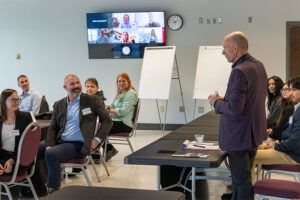
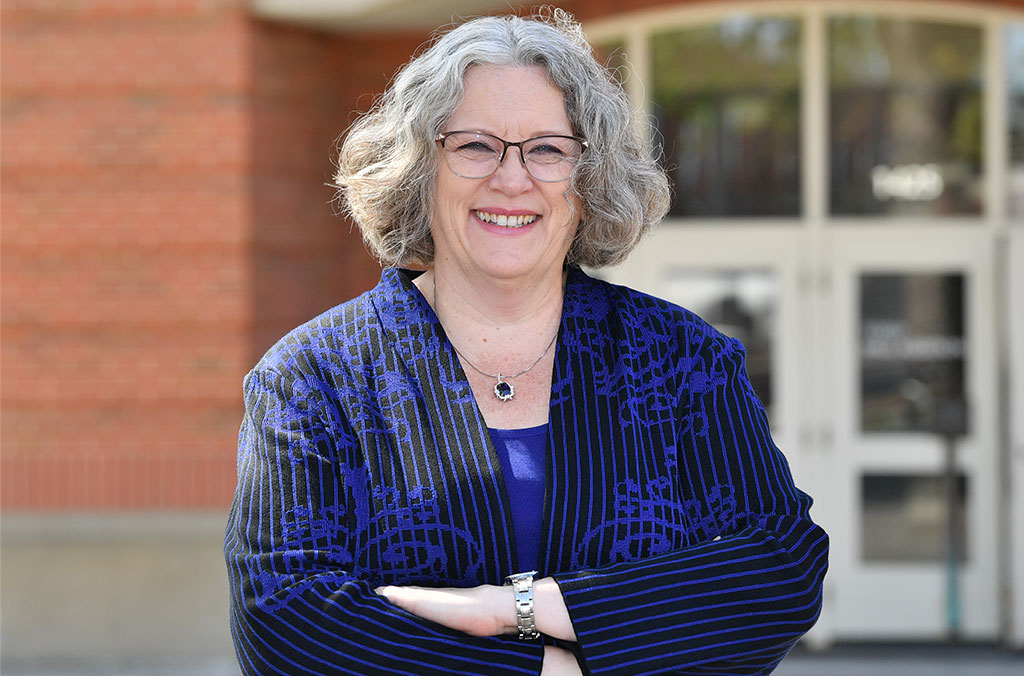
WSU Tri-Cities retired business Professor Joan Giese—then-director of Cougar Tracks—spent six months collaborating with the US Department of Energy Hanford Field Office and Hanford contractors to develop the program.
“It took diligent planning and execution by all parties—our collaboration was on steroids,” Giese says. “This is a unique program featuring our very best faculty experts on management topics directly applicable to the work of current and future Hanford contractors.”
Tom Tripp, Carson College of Business senior associate dean for academic affairs, developed curriculum and serves as an instructor and management expert for the academy.
“The academy is the type of partnership that epitomizes WSU’s land-grant mission to provide expertise that helps citizens and businesses of Washington state,” Tripp says. “I’m excited to offer my experience on the psychology of workplace conflict to help Hanford managers prepare for executive leadership.
”The year-long academy started in January, preparing 15 mid-career Hanford contractors to handle challenges C-suite executives face. Six Carson College faculty lead sessions on the following topics:
- Building trust, led by Professor Tom Tripp
- Communication and persuasion, led by Associate Professor (Career Track) Chris Cooney
- Teamwork and collaboration, led by Professor Jeremy Beus
- Negotiation and managing conflict, led by Professor Kristine Kuhn
- Culture and change management, led by Associate Professor Leah Sheppard
- One Hanford positioning and messaging, led by Professor Andrew Perkins

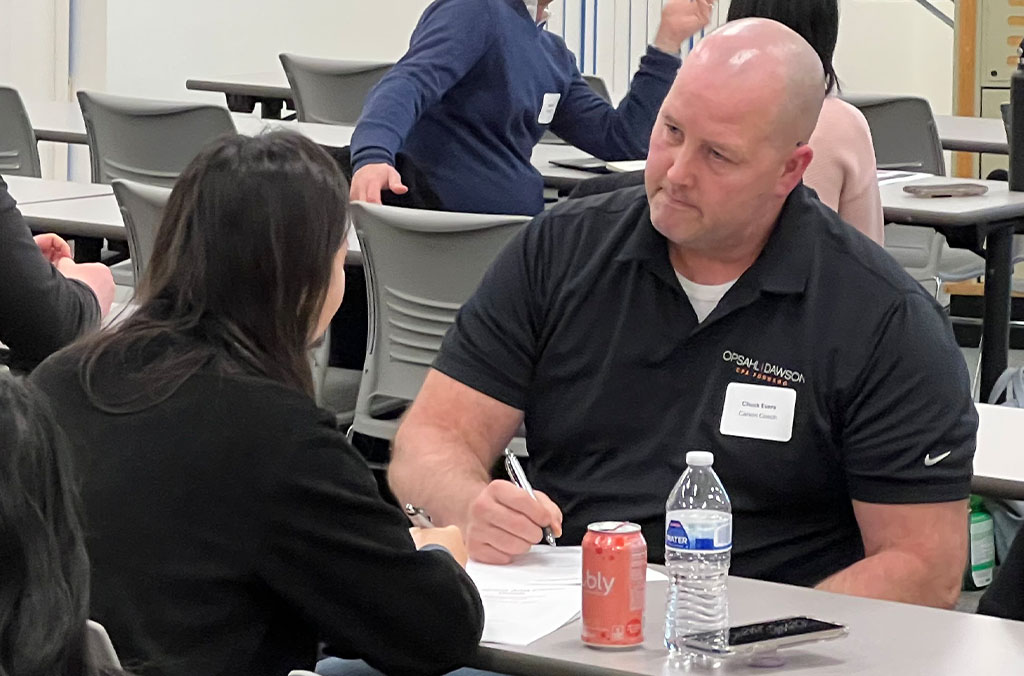
The sessions are separated by project workshops, where participants work alongside facilitators Wade Larson, WSU Global Campus professor, and Doug Steck, WSU Vancouver executive in residence. There are no exams; each participant applies the skills developed in the sessions to complete a project.
“Key takeaways for me were the importance of communication and understanding your own values as a leader,” says participant Garrett Knutson, ES&H director at Navarro-ATL. “With a strengthened network of peers and enhanced skill set, I am better equipped to contribute to the success of the Hanford mission.”
Participant Casey DeGroof, Hanford Mission Integration Solutions deputy vice president of safeguards, security, and emergency response, says the training on building organizational trust, establishing fair practices, and addressing factors contributing to political conflict are foundational to achieving success across Hanford.
“This opportunity is not just about building or reinforcing our leadership skills—it’s about teamwork,” she says. “Understanding how we are all aligned to the same mission is critical to making the best decisions for site remediation, protection strategies, and long-term safety of our community.”
Ensuring a better future
The faculty are excited to help solve challenges and uncertainties Hanford contractors face.
“Using evidence-based strategies to help people working in organizations and facing real-world problems is one of the best parts of my job,” Sheppard says.
“The Hanford Site team is doing essential work to ensure future generations in Washington state live in a safe and thriving environment. They are deeply committed to that mission, and each is personally committed to achieving a shared vision,” Cooney says. “It is an honor and privilege to play a role in helping them work together to achieve their goals.”
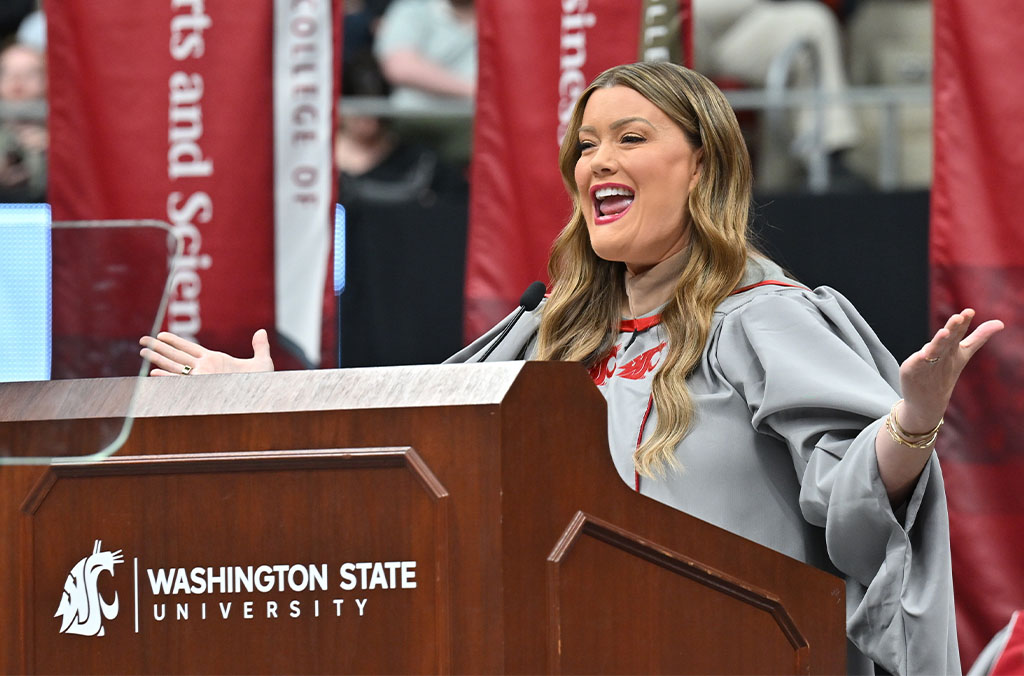
Michelle Hrycauk Nassif, the current director of Cougar Tracks, says the university is cultivating a workforce that will not only excel within the Hanford ecosystem but also drive economic and technological growth in the Tri-Cities region.
“Our Cougar Tracks programs are designed with industry collaboration at their core, ensuring we not only meet but anticipate the workforce development needs of STEM-driven enterprises,” Hrycauk Nassif says. “The One Hanford Leadership Academy exemplifies this partnership, leveraging the strength of our research expertise and our innovative learning programs to prepare mid-level managers for transformative leadership roles.”
The academy’s organizers hope to welcome a new set of cohorts each year.
“Hanford is one of three nuclear research and development sites in the US that comprised the Manhattan Project during World War II,” Tripp says. “As a potential outcome, we would love to see the One Hanford Leadership Academy expand to the other Manhattan Project sites in Los Alamos, New Mexico, and Oak Ridge, Tennessee.”