By Sue McMurray
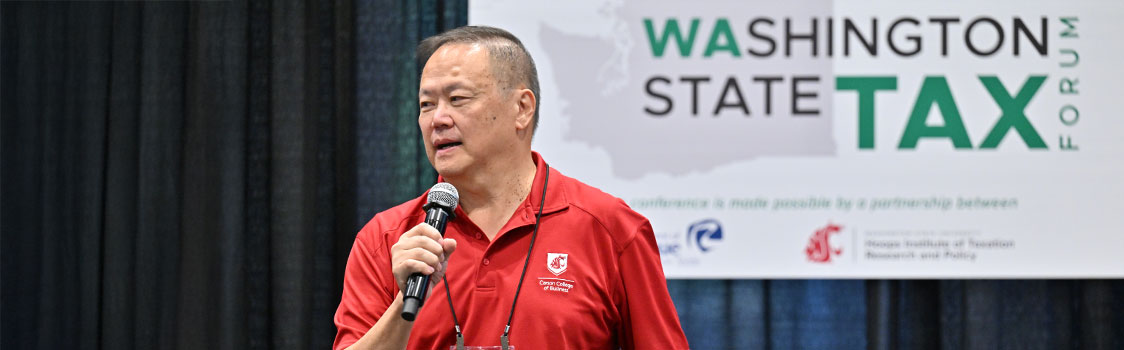
Balance. For accounting professor Bernard (Bernie) Wong-On-Wing, the word carries symbolic weight beyond is role in financial reconciliation. It’s more than a professional philosophy that guides his teaching, research, and leadership of the Carson College Department of Accounting. It’s how he approaches life.
When he earned his PhD from Arizona State University in 1986 and was looking for a faculty position, Wong-On-Wing was attracted to the healthy balance of teaching and research at the WSU business college. The sense of community within the college and the quality of the accounting program were the right fit, he says. The program had recently become accredited by the Association to Advance Collegiate Schools of Business (AACSB) in 1984—a distinction that would have bearing on Wong-On-Wing’s later role as department chair.
As a faculty member, Wong-On-Wing focuses on teaching cost and managerial accounting courses and researching topics including investor decision-making, controls in organizations, and accounting implications of cultural differences. He also is the faculty director of the Business in China program in partnership with the Southwestern University of Finance and Economics.
“Bernie cares deeply about students and the student experience, and he has been a research leader in the department for many years,” says David Whidbee, Carson College senior associate dean for faculty affairs and research. “In many ways, our accounting program reflects Bernie’s balanced commitment of being very focused on impactful research while also being very student-focused.”
Because of these leadership qualities, Wong-On-Wing was awarded the Ted Saldin Distinguished Professorship in Accounting in 2013. The professorship honors Saldin’s legacy of mentorship and providing quality education to every student. Funding from the professorship helps Wong-On-Wing conduct scholarly work.
“I am profoundly grateful to our generous donors, whose commitment to faculty excellence helps us attract and retain top researchers and educators like Bernie,” says Debbie Compeau, Carson College dean. “When we honor and empower our faculty through endowed professorships, we drive innovation, uphold academic excellence, and shape a stronger future for our students.”
Holistic framework aims to sustain program quality
In 2020, Wong-On-Wing was appointed chair of the accounting department, responsible for strategically leading the department not only through the pandemic but also sustaining the program’s AACSB accreditation and overall quality.
From the beginning, Wong-On-Wing approached managing the department from a holistic standpoint. He worked with faculty to develop a framework comprised of four components: input, process, output, and giving back. He presented this strategy during the accounting program’s AACSB’s accreditation review in 2024, and accreditation was renewed for another six years.
“Our holistic approach starts with recruiting quality students and building a community of accounting professionals who are committed to giving back as alums,” he says. “It’s a whole cycle.”
While the accounting program continues to be focused on student learning (process) and student placement (output), recruiting (input) and giving back are two new components. These two elements will be increasingly important as enrollment size remains uncertain and state-funded resources continue to decline, Wong-On-Wing says.
At the input stage, professionals, accounting advisory board members, and faculty focus on a number of student recruiting strategies. These include speaking at high schools and community colleges as well as informing first-year students about the accounting profession and career opportunities.
The process component consists of two parts: the first focuses on building students’ technical skills, and the second emphasizes the development of students’ professional skills, such as networking and communication.
The output component relates to graduates’ job placement and ensures they are aware of job opportunities. The Carson College is one of a few colleges in the US to have a dedicated departmental accounting relations manager focused on placement. Drew Moreno holds that position in the accounting department, and he assists students with résumé writing, connecting with professionals, and interviewing with the goal of obtaining internship and permanent employment positions.
“Technical and professional skills must be parallel for students to obtain internships and permanent employment,” Wong-On-Wing says. “We bring in professionals to help us train students for the workforce. By cultivating this community, employers will get the product they want.”
Giving back makes a stronger community
The sense of community students have during their accounting degree program doesn’t end with placing them in jobs, Wong-On-Wing says. “We want recent graduates to give back to that community immediately upon entering the profession.”
He says the giving back component helps ensure the sustainability of the accounting program. Alums can contribute financially or in many other ways, for example, by mentoring, recruiting new majors, guest lecturing, assisting students with networking and interviewing skills, and coordinating firm visits.
“Participation makes our community stronger,” Wong-On-Wing says. “The bigger picture is that it not only makes the program better but also strengthens the economy and society as a whole.”
To learn more about establishing an endowment, contact ccb.development@wsu.edu.