

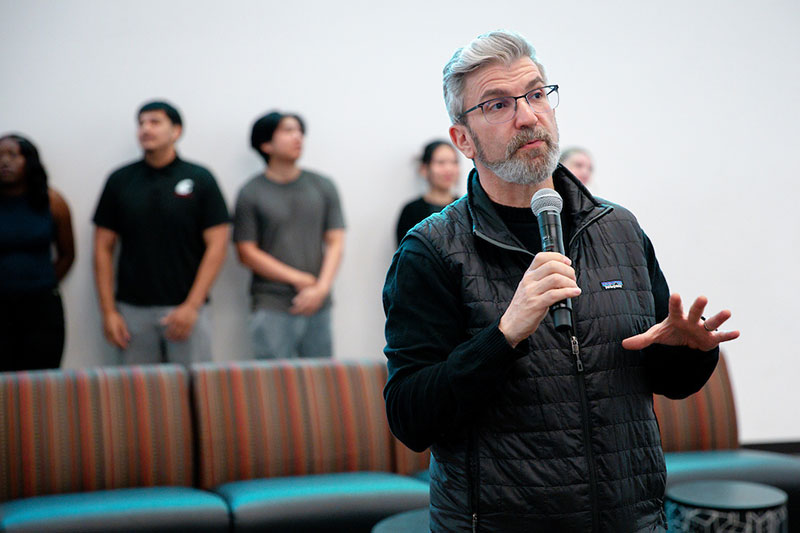
Carson College of Business students in Chris Cooney’s Entrepreneurial Marketing class spent the spring semester tackling a challenge common to entrepreneurs: identify a real problem, develop a solution, and turn that solution into a viable business concept complete with a website, a functional mobile app, and a digital launch campaign. Along the way, they used artificial intelligence at nearly every stage of the process. In the final days of the semester, teams presented their venture concepts to their fellow students.
Keeping humans in the loop
Cooney, an associate professor (career track) in the Carson College’s Department of Management, Information Systems, and Entrepreneurship (MISE), encouraged students to approach the use of AI according to four essential rules, including “always invite AI to the table” and “be the human in the loop.” Together, the principles reflect a central tension in the course: students are expected to embrace emerging tools while remaining responsible for critically evaluating and managing their output.
Working in teams, students developed concepts and value propositions for new ventures before dividing into groups responsible for creating a visual brand and website, or an interactive app prototype. They tested their initial designs with classmates and potential customers, incorporated the feedback into successive iterations, and ultimately presented a complete marketing strategy.
Drawing on more than 30 years of professional experience—including recent work with Google Play Academy, Adobe, and Google’s Blockly Summit—Cooney designed the assignment to develop both the technical fluency and adaptability students will need to make decisions in a professional environment that is rapidly evolving.
“What makes Chris’s class unique and valuable is that students leave with practical experience creating and refining solutions to these problems using modern tools that are being used by professionals in the industry today,” says MISE Department Chair Marie Mayes.
Learning to think like entrepreneurs
For Alexander Loutzenheiser (’27 Entrp.), the assignment stood out because it offered an opportunity to move beyond classroom discussions and develop an idea into something tangible.
“It really gives you the in-depth experience of actually building something from the ground up,” Loutzenheiser says. “Having ideas, using your intuition, and actually making a product come to life entirely is just a great experience.”
Students say the project also encouraged them to stretch beyond their existing strengths. Team members often found themselves contributing in unfamiliar areas while balancing the needs of the group and the demands of the project.
“Marketing, design, websites, and app creation were areas where I don’t have a lot of skill, so to be able to work on them was huge,” says Daniel Barton (’27 Mktg.).
Lucy LaDoe (’26 Mktg.) agreed the lessons extended beyond building an app. She says the experience reinforced skills she expects to use in her career, particularly as emergent technology continues to reshape the pace of marketing and product development.
“I’m going into marketing which will require the ability to make quick decisions and adapt a product or a campaign,” LaDoe says. “I know I will carry the skills I learned here into any future marketing roles.”
Problem-to-prototype practice prepares students for business careers
Cooney says the assignment gives students practical experience with the entrepreneurial process, encouraging them to move quickly from identifying a problem to testing potential solutions. Rather than treating ideas as finished products, students learn to refine them through repeated feedback and iteration—a process he says is rooted in the concept of “design thinking.”
“It’s a way of approaching problems by starting with the human need and going through this iterative cycle—building prototypes, getting them in front of people, and creating that feedback loop,” Cooney says.
While students leave the course with experience using industry-standard software, Cooney says the larger goal is helping them develop a reliable approach to solving problems—one they can carry into future careers regardless of how the technology develops.
Cooney says by working with technologies that continue to evolve at a rapid pace, students also gain experience adapting to new tools and workflows that are increasingly becoming part of the modern business landscape.
“It’s showing them what’s possible,” he says.