

The WSU Center for Entrepreneurship‘s annual Business Plan Competition (BPC) challenges students to move beyond business concepts and test their ideas before entrepreneurs and industry professionals. Along the way, teams refine their products, strengthen their presentations, and gain practical insight into what it takes to bring a venture to life.
While the competition concludes with more than $50,000 in awards and prize money, the experience often marks the beginning of a new chapter for participating teams. This year’s five top-ranked teams share how the competition helped shape their next steps.
Opulence AI
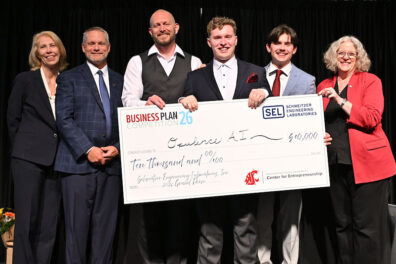
Opulence AI, an artificial intelligence platform that helps residential contractors streamline every stage of building a home, earned the BPC’s $10,000 Schweitzer Engineering Laboratories grand prize and a $2,500 Best Technology Venture award. Founder Aidan Finnegan (’27 Entrep.) says the idea for the venture started with a request from his uncle, a contractor, who wanted an easier way to manage projects and scheduling. Finnegan says what he initially thought would be a week-long project became a much larger undertaking, leading him to recruit cofounders Royse Cozzens, owner of Cozzens Consulting, and software engineering student Ben Swanzey to help develop the platform.
“I’ve always believed any of my ventures can work if I give them enough time,” Finnegan says. “It’s all about understanding the problem and putting in the work.”
As a returning participant in the BPC, Finnegan’s Rainmaker Solutions venture placed third in the 2025 competition. He says the BPC experience reinforces Carson College entrepreneurship lessons that pushed students to defend, refine, and strengthen their ideas before seasoned entrepreneurs and investors.
Finnegan says the team now has its first paying customer and plans to reinvest its prize winnings into customer outreach and marketing.
Amplifi
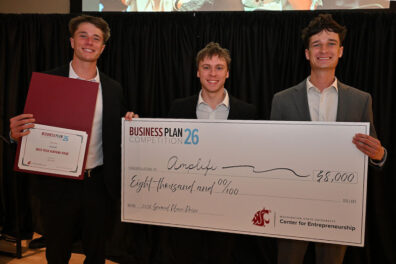
Second-place finisher Amplifi won $8,000 and earned an additional $2,500 Best Technology Venture award for its financial platform designed to help Gen Z users better understand and manage their finances. Bringing together expertise in finance, management information systems, and marketing, teammates Luke Rehberger (’26 Finance), Ryan Hundevin (’26 Mktg., Entrep.), and Caden Roth (’26 Finance, Mgmt. Info. Sys.) developed the platform to combine banking, investment, and loan accounts into a single dashboard while incorporating a social component that encourages users to learn from peers with similar financial goals.
“Gen Z doesn’t always have access to financial advisors or paid subscription services, so we wanted to build something that would be free to use,” Hundevin says.
The project challenged the team to combine their different academic backgrounds while navigating questions ranging from financial privacy and user experience to business strategy and long-term commercialization. Rehberger says presenting before experienced entrepreneurs and investors through the BPC helped strengthen the team’s confidence in the venture’s potential.
“As we graduate and begin heading out into the workforce, we’re going to sit down together and decide how we want to move the venture forward,” Rehberger says.
Arvella
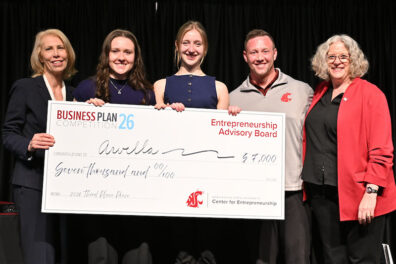
Third-place finisher Arvella earned $7,000 and the $2,500 Best Trade Show award with a subscription-based craft kit designed to help aspiring artists develop new creative skills. Team members Elsa Loos (’26 Entrep., Mgmt. Info. Sys.)and Whitney Van Gorkom (’26 Mgmt. Info. Sys.) combined guided art projects with AI-powered feedback, creating a platform that supports beginners as they learn painting while laying the groundwork for future craft offerings. Instructor-led tutorials help users continue learning between lessons.
“At Carson we’ve learned not only how to build a successful business, but how to build one that’s ethical and user-friendly,” Van Gorkom says.
Van Gorkom says they plan to launch an initial batch of 50 kits and gather feedback before expanding the platform into additional creative hobbies such as pottery and crochet. She says the BPC reinforced the value of testing ideas with real users, embracing feedback, and refining the venture before pursuing broader growth.
“We’re planning that small launch first so we can learn what’s working, find the flaws, and keep improving before we grow,” Van Gorkom says.
RECOVR
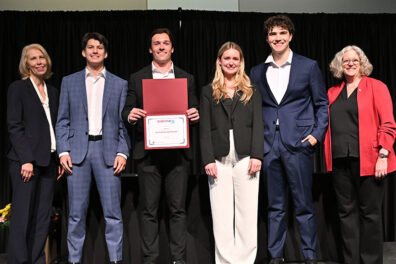
RECOVR earned fourth place and the Best Social Impact Venture award, taking home a total of $6,500 in cash prizes, for its intelligent, patient-monitoring platform that helps addiction treatment providers identify patients at risk of relapse and deliver more personalized care. The idea grew from firsthand research, with biology student William Mroch drawing on his experience working with patients in WSU opioid addiction research labs. Mroch says the venture demonstrates how research and entrepreneurship can work hand in hand to address complex public health challenges.
Mroch partnered with Madison DeSpain (’26 Entrep.), mechanical engineering student Jimmy Pruiett (’27), and Keegan Shone (’26 Entrep.) to tackle the technical, clinical, and business considerations involved in developing RECOVR. Team members say the BPC introduced them to alumni, patent attorneys, and funding opportunities while providing feedback from entrepreneurs and health care professionals. Those conversations helped clarify the next phase of development as RECOVR moves toward clinical testing and partnerships that could help bring the platform into treatment settings.
“The competition wasn’t validation for us—it was an opportunity to keep moving the idea forward,” DeSpain says.
Meat & Potatoes
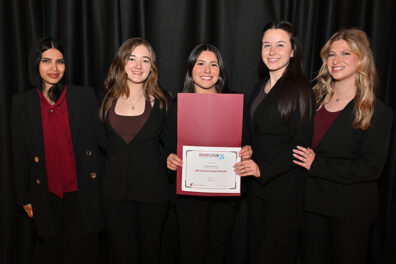
Fifth-place finisher Meat & Potatoes earned $2,000 for its restaurant training platform designed to improve communication and onboarding in fine-dining operations. The idea originated in a Hospitality Business Management capstone course, where students pitched individual business concepts before selecting the one they believed held the greatest potential. Drawing on their own experience working in restaurants, the team identified a common frustration: new employees often rely on outdated manuals and inconsistent training while learning the job.
“We noticed a gap in the industry because we experienced it ourselves,” says Halle Cohen (’26 Hospi. Busi. Mgmt.).
Although the venture began as a class assignment, the team challenged themselves to enter it in the BPC. Leading up to the competition, the team developed a business model for their training platform, pitched it to experienced entrepreneurs, and adjusted their ideas. Cohen says the experience helped build confidence while introducing the team to concepts they hadn’t previously encountered, from investor presentations to entrepreneurial problem solving.
“We’ve been presenting every week, and seeing how much we’ve improved has been really inspiring,” Cohen says.