
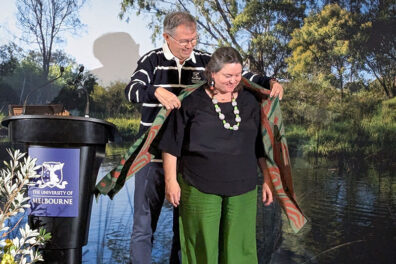
Joseph Scott Gladstone, an associate professor (career track) at WSU Everett, is working with partners at the University of Melbourne to explore how Indigenous perspectives can influence the way organizations think about leadership, entrepreneurship, and decision-making. Gladstone says his work brings together scholars and practitioners who are examining how Indigenous cultural values inform business practices across the world.
Building international partnerships through shared ideas
Gladstone’s connection with the University of Melbourne grew out of longstanding professional relationships and shared research interests with the Dilin Duwa Centre for Indigenous Business Leadership at Melbourne Business School. As an international academic with the center, he contributes to conversations about Indigenous entrepreneurship while also teaching Indigenous business management courses for students across Australia.
Last October, he traveled to Australia to participate in the Dilin Duwa Dialogues, a global gathering of Indigenous scholars and business leaders focused on collaborative research.
“The Dilin Duwa Dialogs brought academics together with practicing Indigenous business people on a global level,” he says. “That event was concerned with facilitating discussions between the academics and the practitioners and coming up with applicable research strategies and projects.”
Gladstone says initiatives like the dialogues help build connections not only between institutions but also between students, faculty, and practitioners whom may otherwise never meet. By sharing perspectives across continents, programs like Dilin Duwa allow participants to compare experiences and explore how business education can evolve to better address their unique cultural values.
The collaboration reflects a growing interest among universities in creating international partnerships that move beyond traditional exchanges. Gladstone says the work highlights how similar questions about identity, entrepreneurship, and community impact are emerging across different Indigenous groups.
Connecting Indigenous worldviews and business practice
Rather than focusing solely on profit, many Indigenous traditions emphasize responsibility to community, relationships with the natural world, and long-term thinking that considers past and future generations.
“Capitalism is kind of a self-serving pursuit, but an indigenous worldview is that you don’t do things selfishly. You always do things to serve the community,” Gladstone says. “We’re basically helping to answer the question of how entrepreneurial work, where you actually are making money for yourself, can serve the community.”
In the classroom, these ideas often resonate with students who feel tension between traditional business training and their cultural identities. Gladstone’s teaching encourages students to reflect on their values and apply them to real-world management challenges.
“The class helps reconcile a cognitive dissonance—they don’t have to surrender their identity as Indigenous people in order to practice business,” Gladstone says. “They can actually use their identity as a strategic or tactical resource to approach and solve business problems using an Indigenous lens.”
While Indigenous cultures vary widely across regions, Gladstone says there are common threads in how communities approach business. Concepts like respect for place and shared responsibility often shape how Indigenous entrepreneurs define success, even when working within modern corporate systems. Through his work with Australian colleagues, he has seen how these perspectives can transcend geography, creating opportunities for mutual learning between Indigenous groups separated by oceans but connected by similar histories.
Looking ahead to future exchange and growth
As the partnership with Melbourne continues to develop, Gladstone hopes to expand opportunities for students through joint course work and potential study abroad experiences. One idea under discussion would pair WSU and Melbourne students in a shared online class, with plans to eventually have them travel and learn on each other’s campuses.
“The idea is that they get this cultural exchange of Indigenous ideas, where they can see where they’re aligned,” he says. “But while they’re in this different country, they’d automatically have hosts to explain things for them.”
Beyond student exchange, Gladstone hopes to eventually establish a center for Indigenous business research at WSU—a space dedicated to studying how Indigenous communities practice business and leadership on their own terms. He sees the partnership with Melbourne as an early example of what that kind of work could look like, bringing together scholars, students, and practitioners to explore questions that few institutions are currently examining in a sustained way.