
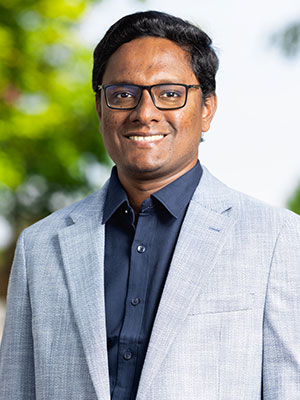
Doctoral student Muhammad Kamrul Hasan didn’t always picture himself as an academic researcher. As a young finance graduate in Bangladesh, he envisioned a future in the corporate world, working for a large multinational company. When he earned a spot in a leadership development program at a major nonprofit, he thought he was well on his way.
Guided by mentors Bhaskar Das and Tahya Hossain, Hasan discovered a fascination with human resources and people management.
“This opportunity changed everything for me—my career and my goals,” he says. “The impact on my passion for managing people was unprecedented.”
He went on to earn an executive MBA and landed a role in HR with a top global consumer goods company. But the reality of long hours, limited support, and a high-stress culture soon took a toll. The experience became a turning point.
Seeking a path more aligned with his growing interest in people management, Hasan earned a Chevening Scholarship to pursue a master’s in business psychology at the University of Leeds. The program deepened his understanding of how employees think and feel at work and solidified his decision to pursue a research-focused career. After receiving his degree, Hasan returned to Bangladesh as a lecturer at North South University, where his classroom experience further inspired him to seek a PhD at WSU.
Research rooted in experience
Now a doctoral student in management at the Carson College of Business, Hasan is exploring many of the same questions he thought about during his time in the corporate world. His dissertation investigates how conflicting emotions, such as fear and passion, interact in toxic workplace climates and influence employee decision-making and behavior.
“My research focus is deeply personal,” Hasan says. “I experienced conflicting emotions firsthand, and that made me want to understand how others navigate those feelings in their own workplaces.”
In one study, Hasan and Ben Warnick, associate professor of entrepreneurship at WSU Vancouver, examined how entrepreneurs respond to emotional conflict when receiving negative feedback on a business idea. Contrary to expectations, they found that high levels of passion amplified feelings of fear, making entrepreneurs more likely to pivot or change their course. The findings underscore how strong emotions can both motivate and destabilize decision-making in high-stakes environments.
In June, early findings from the research were presented at the Babson College Entrepreneurship Research Conference (BCERC). The research conference paper, coauthored by Hasan and Warnick, was recognized as one of the top 40 papers and will be published in the 2025 edition of Frontiers of Entrepreneurship Research, the BCERC proceedings.
Mentorship and momentum at Carson
Hasan credits his development as a researcher and scholar to the mentorship he’s received at the Carson College. His dissertation committee professors Jeremy Beus, Warnick, and Stephen Lee each contributed unique and valuable perspectives to his research.
“Every piece of feedback I get is a learning moment,” says Hasan. “They challenge me to think more critically, justify each part of my research design, and build models that truly matter.”
As part of his dissertation, Hasan has also collaborated on a meta-analysis of toxic workplace climates with Beus, who is also his doctoral advisor, and is beginning a third project that ties his interests in emotional conflict and workplace toxicity together. These research collaborations, he says, have strengthened both his academic identity and confidence.
Balancing roles, building skills
The demands of the PhD program have been considerable, Hasan says, but not discouraging. He also became a first-time father during his first year, adding a layer of responsibility to an already full schedule.
“There are too many things to accomplish in too little time,” he says. “But I’m learning to multitask, be a good researcher, a good father, and a good partner. Every day, I’m becoming a better version of myself.”
In addition to research, Hasan is building his teaching portfolio. After teaching global summer courses, he is preparing to lead a large undergraduate course in organizational management this fall. He sees the classroom as a space to bring research insights to life and to mentor students on their own professional journeys.
“I want students to pursue what they’re truly passionate about, not just what others expect of them,” he says. “That’s how they’ll thrive in the long run.”
Pursuing purpose through research and teaching
Hasan envisions a career that combines research, teaching, and mentorship. It’s a vision grounded in personal experience, shaped by reflection, perseverance, and a deep belief in the human side of business.
He hopes to join a university where he can continue studying workplace dynamics while helping students discover meaningful paths of their own.
“Through my research, I want to show how emotional experiences at work affect employee behavior and performance,” he says. “And as a teacher, I want to help students find their own voice and purpose.”