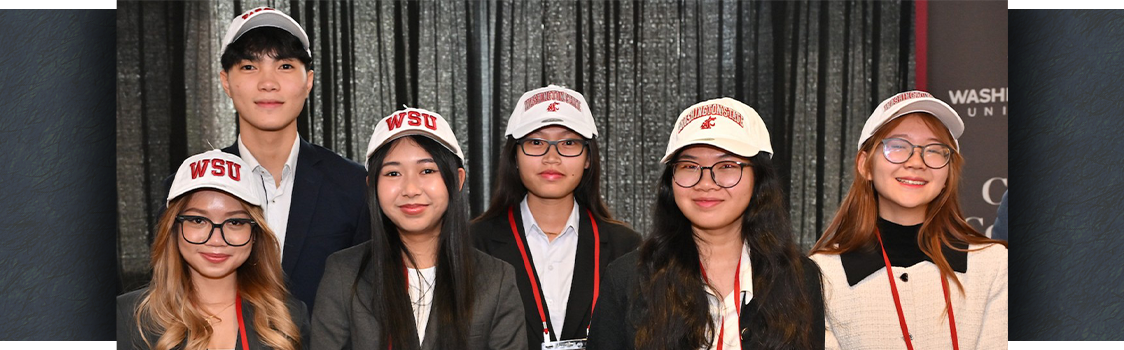
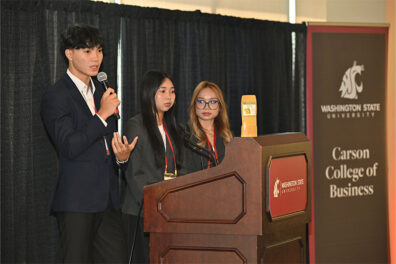
Two student-led ventures from Cambodia’s CamEd Business School traveled more than 9,000 miles to present their business plans at WSU’s annual Marketing and International Business Symposium this April. The students showcased innovative agricultural products alongside Carson College peers, participating in the event as part of a growing international collaboration between the two institutions.
Hosted by the Department of Marketing and International Business, the symposium gave the visiting teams a platform to share two sustainability-driven projects developed through CamEd’s entrepreneurship center. One, called Ompovision, uses sugarcane byproducts to create affordable poultry feed. The other, Mango Glow, turns mango peels discarded by industrial fruit processors into nutritional supplements. Faculty leaders from both schools say the visit is the start of something bigger.
“We were thrilled to host the CamEd teams and showcase their innovative work,” says Jeff Joireman, director of the Carson College’s International Business Institute. “Their visit brought fresh ideas and global perspective to the symposium, and our students gained a lot from the exchange. We’re excited to build on this partnership and explore more opportunities for collaboration in the future.”
A transformational experience for students
For the visiting CamEd students, presenting at WSU offered more than a chance to showcase their work. It was an opportunity to build confidence and gain perspective on how their ideas are received outside Cambodia.
“This was our first time presenting our project outside our home country,” says Sokunpidor Lonh of Mango Glow. “The thought of sharing our work with an entirely new and international audience was both thrilling and intimidating.”
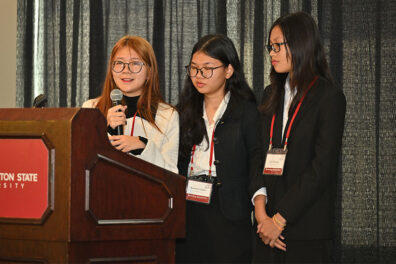
Laklita Bunloeur of Ompovision says the team was initially anxious, but that changed once they engaged with WSU students and faculty.
“We found ourselves on edge over questions the panel could ask us, but we were pleasantly surprised when some of the WSU students were curious about what we’ve done so far and how we felt about it,” Bunloeur says.
The students also praised the hospitality and kindness they received throughout their stay, citing everything from campus tours to a dinner hosted by Carson College faculty.
For both teams, the trip broadened their ambitions.
“Presenting our venture on an international stage opened our eyes to its broader potential,” Lonh says. “The interest and feedback we received inspired us to think bigger and consider expanding into new, larger markets. It was a turning point that made us believe our idea could have global relevance.”
Growing ventures and a budding partnership
Assistant Professor Monirul Islam, who runs CamEd’s small entrepreneurship center, led the trip. Each year, the center helps students develop dozens of business concepts and provides small seed grants to help launch viable ideas.
“In Cambodia, people love to do business,” Islam says. “Almost every family has a sort of micro-business. It’s a cultural norm here.”
Rather than focusing on large-scale investments, the center helps students build ventures that can be launched with just a few thousand dollars, making entrepreneurship accessible and low-risk. While students are expected to develop a business, Islam says the main intention for entrepreneurial activities is to build an entrepreneurial mindset.
Both Mango Glow and Ompovision have already seen early success. Mango Glow earned top honors in CamEd’s internal entrepreneurship competition, winning $5,000 and later placing in the top five of Cambodia’s national Business Model Competition. The teams also competed in a July entrepreneurship challenge hosted by the Baoshan government in Shanghai, China.
Back home, both ventures are in soft-launch phases. Mango Glow is already selling its product—a superfood powder derived from mango peels—via social media and local delivery platforms.
Islam says he hopes the visit to WSU is just the beginning of a broader exchange and would like to see WSU students visit Phnom Penh and pitch their ideas in CamEd’s competitions. He hopes CamEd’s students can attend WSU’s annual Business Plan Competition in 2026.
“Whether we win or lose, it doesn’t really matter,” he says. “The experience they’re going to get is going to be amazing.”