
The Center for Entrepreneurship’s annual Business Plan Competition (BPC) attracts dozens of aspiring entrepreneurs each year with a chance to earn monetary prizes to seed their budding ventures. The competition includes not only the WSU College League but also the Foster Garvey Open League and the High School League, which are open to peer universities and regional high schools teams. All leagues compete for additional merit prizes.
For many student entrepreneurs, the BPC is just the beginning. These five top-ranked ventures share how the experience shaped their next steps.
Wearable Aromas
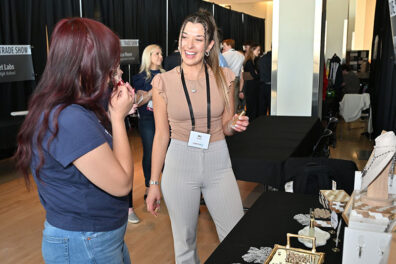
First place at this year’s BPC was awarded to Wearable Aromas—a wax-based solid perfume, housed in jewelry and designed for clean, on-the-go use. Founder Madeline June (MJ) Kunkle (’25 Entrep.) and partner James Harrison (’25 Accounting, Entrep., Finance) were presented with the $15,000 grand prize at an award banquet the evening of the competition. Kunkle says the win marked an important milestone in turning her idea into a viable business.
She credits the entrepreneurship program for preparing her to build and pitch a market-ready product.
“I was able to apply almost everything that I was learning in my classes directly to the business,” she says. “Entrepreneurship was the right major for me—it was great for honing important skills and helping me figure out where I fit in the business world.
While the competition provided a financial boost, Kunkle says it also pushed her to grow.
“Even if I had failed, I still learned so much, and I got amazing feedback,” she says. “In some ways, the value of pushing yourself out of your comfort zone was by far the biggest and most rewarding part.”
Following the competition, Kunkle was surprised with a matching $15,000 award from IT Cosmetics entrepreneur and Carson alum Jamie Kern Lima (’00 Busi. Admin.). With a provisional patent already secured, she is now focused on making sales through farmers markets and pop-up shops. Her process includes fostering relationships with small boutiques that might carry her product, growing her online presence to ramp up production, and eventually making the venture her full-time career.
Kerat AI
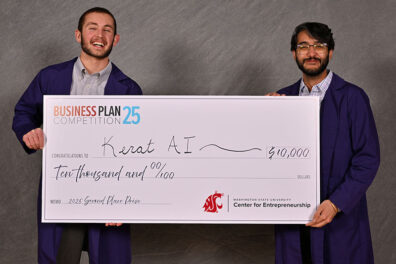
A venture called Kerat AI was the second biggest winner, earning second place and Best Technology Venture for a total of $12,500.
Founder Jasson Makkar (’25 PhD Molec. Biosci.), developed a personalized marketplace that helps consumers monitor their hair health and discover the right products for their specific hair type.
For Makkar, who comes from a research background, the competition was a turning point that helped him and his team clarify their go-to-market strategy and make valuable industry connections.
“It’s a pretty big shift—going from improving technology in a lab to solving real-world problems with limited resources,” he says. “If not for the Business Plan Competition, we’d probably just be toiling away endlessly on the technology without actually moving it closer to market.”
Since the competition, Makkar and partner Mason Matich (’25 Gene. & Cell Biol.) launched a research collaboration with an outside company to further develop their technology and participated in the University of Washington’s Dempsey Startup Accelerator. Both experiences will expand their network and refine their business model as Kerat AI prepares for investors and market launch.
Rainmaker Solutions
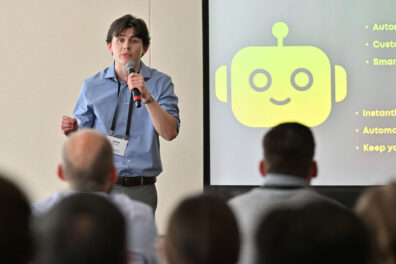
Rainmaker Solutions, an automation platform for mobile car detailers, earned third place and $7,000. The venture, founded by WSU student Aidan Finnegan (’27 Entrep.), uses AI to help detailing businesses streamline marketing, lead generation, customer engagement, and internal operations.
Finnegan says running his own car detailing business inspired him to build a venture that helps service-based entrepreneurs scale more effectively and affordably. Participating in the competition helped clarify his business model.
“I figured out some simple branding stuff and really meditated on services detailing businesses would need,” he says. “The BPC gave me such a good reason to figure out how the business is actually going to work.”
Since the competition, Finnegan has brought on a technical cofounder, landed his first paying clients, and expanded his platform to serve small construction firms. As a next step, he hopes to sign 10 automation clients and refine his venture’s offerings.
Driveway Pitstop
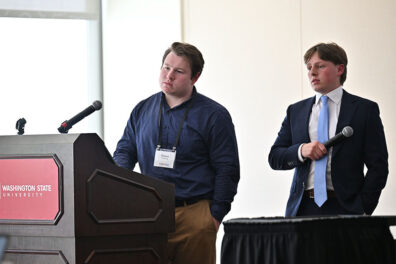
Driveway Pitstop, a mobile mechanic and oil change service that brings vehicle maintenance directly to customers’ homes, won fourth place and $4,000. Created by business students Mason Pickering (’25 Mgmt. Info. Sys., Entrep.) and Ben Kapsandy (’25 Entrep.), the venture stood out for its convenience-focused model and lack of direct competitors in the market.
For Pickering, the experience was a powerful supplement to his academic career.
“I learned more with the BPC experience than I have throughout my whole college career,” he says. “It actually played a vital role in showing me how planning and operating a real business would look.”
Through the competition, the team gained a deeper understanding of market research, financial planning, and the real-world viability of their idea. Judges and visitors expressed strong interest, reinforcing their belief that Driveway Pitstop could fill a genuine market need.
Following their graduation in spring 2025, the cofounders have placed the venture on hold while they gain additional industry experience—but say the door remains open to launching the business in the future.
Miata Fitment
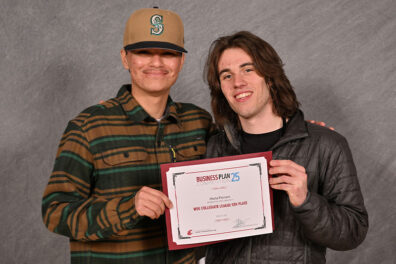
Miata Fitment, a platform designed to simplify wheel, tire, and suspension selection for Mazda Miatas using a 3D visualizer, earned fifth place and $2,000.
Founded by computer science major Anthony Devito (’25 Comp. Sci.) and cofounder Antonio Casila (’26 Busi. Admin.), the platform grew out of Devito’s personal interest in the Miata community and desire to streamline a process that often left car owners guessing. Matching the correct parts to a specific generation of Miata can be notoriously tricky, and mistakes can be expensive. This inspired Devito and Casila to develop an online tool to eliminate that uncertainty.
Though the product was already live with an active user base, Devito says the competition pushed him to think more strategically about how the venture could grow as a business.
“The biggest benefit of participating in a competition like this comes from the support you get from the people, not only the organizers, but the judges and other participants as well,” he says. “The BPC fosters an environment where it’s less like competition and more collaborative—everyone wants to help everyone.”
Since the competition, the team has expanded the platform to support additional Miata models and is preparing to launch subscription features. Their long-term goal is to continue to improve the visualizer into a tool that can be adapted to work for a wider range of car brands.