
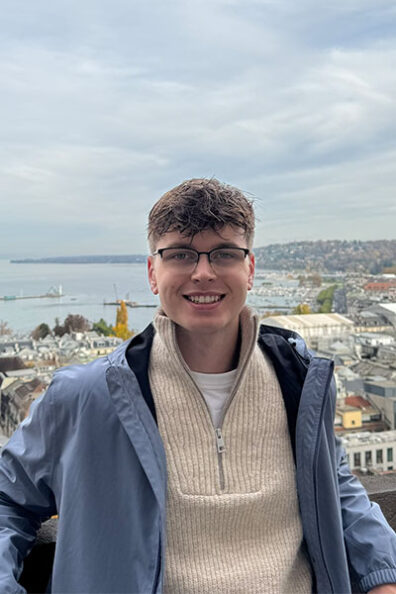
Stan de Keijzer (’26 Intl. Busi., Finance) saw studying abroad at the University of St. Gallen in Switzerland as a natural next step in his academic career. Having grown up in the Netherlands before moving to the United States, he arrived at WSU with an appreciation for different cultures—an interest that led him to pursue a double major in international business and finance in the Carson College of Business.
De Keijzer says this perspective has only deepened through his experiences at the Carson College. As he sees it, the field reflects the interconnected nature of the modern business world.
“They say you’re studying international business, but really you’re just studying business, because almost everything is international,” he says.
Building global perspective
De Keijzer says his time studying abroad, as well as his experience moving between countries as a child, had a strong effect on how he understands the role culture plays in peoples’ professional and personal lives. Even small differences—how people communicate, study, or present themselves—offer insight into how perspectives can vary across environments.
He says this awareness continued to grow in his time studying abroad, where he worked beside students from around the world. The experience reinforced the value of understanding different viewpoints, which he says is key for working across cultures in any business setting.
De Keijzer chose the University of St. Gallen exchange program for both its academic reputation and unique cultural landscape. Known as a global finance hub, the country offers an opportunity to experience a blend of languages and traditions.
He says the academic structure itself was a change of pace—courses were more intensive, often condensed into shorter timeframes, and taught by instructors with extensive industry experience. In one course, he worked with a group to deliver a 40-minute presentation, an experience that highlighted the need to coordinate ideas across different perspectives. Outside the classroom, a buddy system connected exchange students from across the world, making it easier to build relationships.
“Group work especially brings together so many different perspectives,” he says. “Each person approaches things differently, and that makes the outcome stronger.”
Developing real-world skills beyond academics
De Keijzer says the experience challenged him to adapt in ways that extended beyond academics. From adjusting to a new education system to navigating daily life in a different language, each situation required flexibility and problem-solving.
“After studying in Switzerland on my own for four months, other challenges feel a lot more manageable,” he says. “The biggest takeaway was communication—understanding how people process information and adjusting how you present it is key in international business and just in life.”
De Keijzer says this insight carried into the relationships he built, where adapting how he communicated helped him form connections and underscored the importance of networking principles he had begun developing at Carson.
Following graduation, de Keijzer plans to move to Arizona to work for Boeing in their Finance Career Foundation Program, a two-year rotational program designed for early-stage finance professionals providing hands-on experience across Boeing’s US production sites. He says the role builds momentum toward the kind of global career he began preparing for at Carson.
“Ultimately, I hope to build a career that brings me into contact with people from many backgrounds while allowing me to contribute to work that creates lasting, meaningful impact,” he says.